The Minimum Genome for a Single Primitive Cell
When the molecules-to-man evolutionary hypothesis and the spontaneous-origin-of-life hypothesis came
out, no one understood the nature or complexity of DNA. Now natural scientists are beginning to
understand.
To find out what the minimum genome might be for a single-cell that can autonomously self-replicate,
scientists studied the genome of the species Mycoplasma mycoides, a parasite, and one of the
smallest bacterial cells known, normally having a genome of about 1000 genes (with around 1,100,000
nucleotide base pairs) depending on the strain.[1] Other bacteria, such as E. coli, may have 4.000
to 5.000 genes.[2]
These scientists essentially knocked out all genes that weren't totally necessary for the bacteria
to survive and replicate in a controlled environment and determined that this stripped down cell,
with 473 genes, dubbed “JCVI-syn3.0”, constitutes the simplest possible living organism. Thus, a
cell with 473 genes appears to be about as streamlined as a cell can be and still survive, albeit in
a glucose culture, allowing evolutionists to imagine what a “primitive” cell genome may have looked
like.[3]
(It is important to note that a gene encodes for a function. Each gene is composed of a particular
sequence of “nucleotides” which are four types of “chemical letters” that tell little molecular
machines in the cells of living things how to assemble amino acids which are necessary for the
construction of the building blocks of all kinds of plants and animals.)
In this stream-lined cell, it is unclear what 149 of these genes do. 70 of them can be broadly
classified but the role they play is unknown. The function of 79 of them is a complete mystery.[4]
The complete genome of JCVI-syn3.0 is composed of 531,560 nucleotides.[5]
(Note that these bacteria
are parasites, so they could not live without a host. This number is realistically too small for a
true stand-alone cell, but it will be used here for argument’s sake.) To get an idea of the
complexity of a sequence 531,560 nucleotides, imagine filling an 8.5 x 11” page of paper with the
precise nucleotide sequence, 3000 characters per page with no spaces; this would take 177 pages of
perfectly sequenced, error-free data (since with a minimalist genome, even a single error will
almost certainly render the entire genome inoperable).[6]
There have only ever been two ways that so many
nucleotides have been observed to be sequenced in this way: 1) in an already functional, living
cell, or 2) by intelligent intervention. It is inconceivable how such a huge nucleotide sequence
could arise spontaneously otherwise.
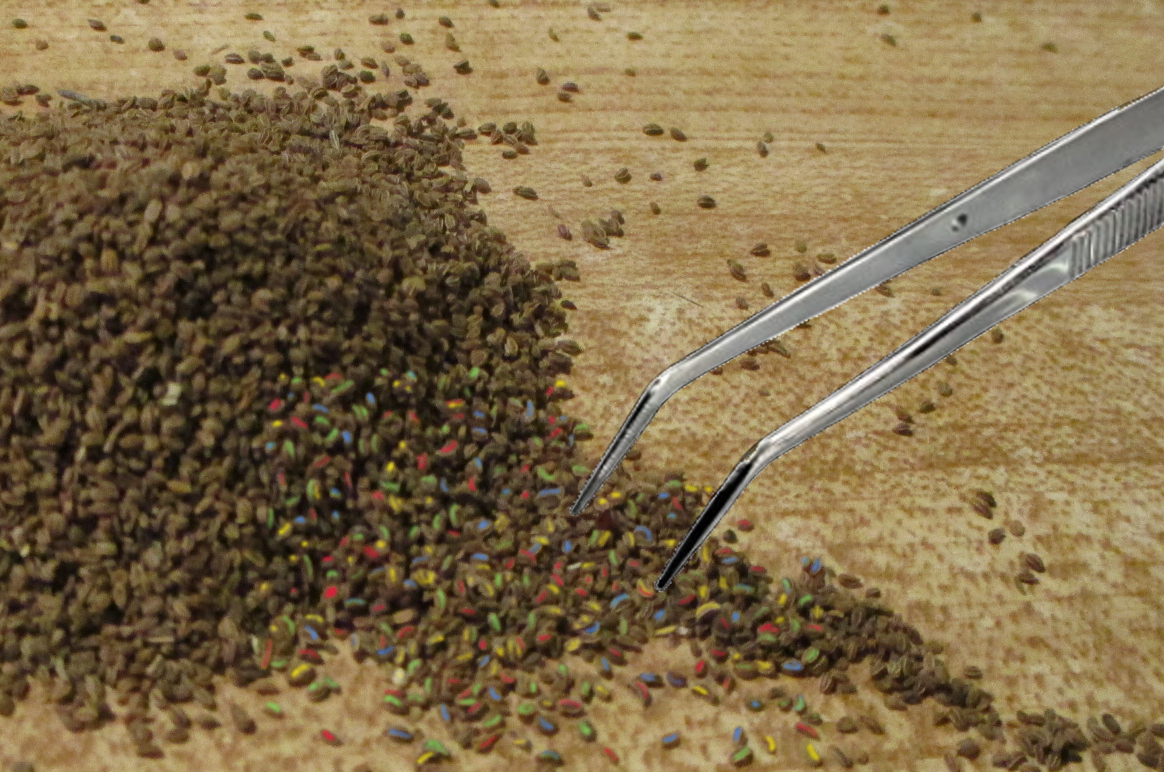 To visualize this number of nucleotides (531,560), think of small seeds and tweezers. Imagine being colorblind and
counting half a million seeds by hand, lining them up randomly, four different colors, seed by seed, by chance, in a
precise order, without a single error since with a minimalist genome, one error will render the cell
non-viable.[7]
One might also imagine assembling 531,560 pieces of four-letter code in such a way
as to provide a specific set of instructions to carry out a variety of complicated sequential tasks.
Then imagine all this precise lining up happening in the first complicated cell, without any template, but only by chance.
This
531,560 is not a small number and it is especially hard to believe that such a huge number of
nucleotides, all in a precise working order, coded for sustaining and regenerating life, could have ever lined
up by random chance along with all the other complicated parts of a cell. The large and necessarily entire
sequence (smaller could not survive or reproduce) could not have realistically arisen randomly and spontaneously
all in one location and at one time anywhere on the face of the earth.
To visualize this number of nucleotides (531,560), think of small seeds and tweezers. Imagine being colorblind and
counting half a million seeds by hand, lining them up randomly, four different colors, seed by seed, by chance, in a
precise order, without a single error since with a minimalist genome, one error will render the cell
non-viable.[7]
One might also imagine assembling 531,560 pieces of four-letter code in such a way
as to provide a specific set of instructions to carry out a variety of complicated sequential tasks.
Then imagine all this precise lining up happening in the first complicated cell, without any template, but only by chance.
This
531,560 is not a small number and it is especially hard to believe that such a huge number of
nucleotides, all in a precise working order, coded for sustaining and regenerating life, could have ever lined
up by random chance along with all the other complicated parts of a cell. The large and necessarily entire
sequence (smaller could not survive or reproduce) could not have realistically arisen randomly and spontaneously
all in one location and at one time anywhere on the face of the earth.
In the most basic, simple cell, not just the DNA, but millions of molecules, thousands of amino acids, and hundreds of
complicated structures would have had to spontaneously assemble in exactly the right positions in order for the cell
to function at all. The amount of time needed for such a spontaneous assembly is incalculably
great. The chances that all the working combinations would come together harmoniously is
astronomically small because a so-called “primitive” cell that can reproduce is inestimably more
complicated than most people think.
I do not believe that even the simplest cell could have come into being by chance.